A Blessed Easter to you all!
Photo Description
As of April 20, 2020, this site is no longer active.
Sunday, April 24, 2011
Friday, September 10, 2010
Classic Catholic Books Online
Many of the classic Catholic books, both fictional and non-fictional, can be hard to find. Luckily, technological advances have put them right at our fingertips...literally, your keyboard. And if you have an electronic reading device, most books on these websites can be directly downloaded to your device, depending on the format.
Archive.org, Open Library and Google Books have very large collections. Project Gutenberg and Many Books are smaller but growing. Save for Google Books, each website has a multitude of formats to choose from for download, dependent upon your particular device. Or you can just read online. The cost: only your time.
Just a sample for starters.
Monday, June 28, 2010
Akron Latin Mass: New Location
It was announced on Sunday that the Latin Mass located in the Akron area has been assigned to St. Sebastian, 476 Mull Ave, Akron, Ohio. High Mass at 1pm and confessions heard at 12:30pm.
Saturday, March 27, 2010
"Passion of the Church" MP3
Dear Friends of the TLM,
This Lent, many of us have not had the opportunity to attend a parish retreat or mission. However, you can do this in your very home. I have found a very poignant talk entitled the Passion of the Church. It was given by a priest of the Fathers of Mercy to a Fraternity of St. Peter parish. I whole-heartedly encourage you to download and listen to this MP3 before Lent's end.
This priest hits home on what is really happening in our beloved Church these days. As the Mystical Body of Christ we are undergoing a passion. Moreover, he points to what we need to do as Friends of the Traditional Latin Mass. I trust you will find this talk informative, eye-opening, challenging, and full of encouragement and hope.
In Christ,
Matthew Lewis
Sunday, March 7, 2010
Guide to Latin Prayers: Lesson 06 - Angelus
"The Angelus is a short practice of devotion in honour of the Incarnation repeated three times each day, morning, noon, and evening, at the sound of the bell. It consists essentially in the triple repetition of the Hail Mary, to which in later times have been added three introductory versicles and a concluding versicle and prayer. The prayer is that which belongs to the antiphon of Our Lady, 'AlmaRedemptoris,' and its recitation is not of strict obligation in order to gain the indulgence. From the first word of the three versicles, i.e. Angelus Domini nuntiavit Mariæ (The angel of the Lord declared untoMary). the devotion derives its name. The indulgence of 100 days for each recitation, with a plenary once a month. was granted by Benedict XIII, 14 September, 1724, but the conditions prescribed have been somewhat modified by Leo XIII, 3 April, 1884. Originally it was necessary that the Angelus should be said kneeling (except on Sundays and on Saturday evenings, when the rubrics prescribe a standing posture), and also that it should be said at the sound of the bell; but more recent legislation allows these conditions to be dispensed with for any sufficient reason, provided the prayer be said approximately at the proper hours, i.e. in the early morning, or about the hour of noon, or towards evening. In this case. however, the whole Angelus as commonly printed has to be recited, but those who do not know the prayers by heart or who are unable to read them, may say five Hail Marys in their place. During paschal time the antiphon of Our Lady, 'Regina cæli lætare,' with versicle andprayer, is to be substituted for the Angelus. The Angelus indulgence is one of those which are notsuspended during the year of Jubilee."
The Angelus, Jean-Francois Millet, 1857-1859
A few notes before we start the lesson.
The Ave Maria is not included in this lesson. You can find it in Lesson 04.
A Latin letter h is generally thought of as a note of aspiration, not pronounced as it is in English. Ecclesiastical Latin has two peculiar words in which the h sounds like k. One of those words is in this lesson: mihi.
Something we have not addressed before is the Latin words which contain the consonant combination gn, as in digni. We will pronounce it the same way we pronounce the common pasta dish, lasagne: lah-zah-nyah.
The Angelus may not be as familiar today as some other prayers, be they Latin or vernacular. With that in mind, EWTN provides a good translation here.
Angelus Domini nuntiavit Mariae
(AHN-jay-loos DOH-mee-nee noon-tsee-AH-veet mah-REE-ay)
et concepit de Spiritu Sancto
(eht kohn-CHAY-peet day SPEAR-ee-too SAHNK-toh)
Ave Maria...
Ecce ancilla Domini
(EHK-chay ahn-CHEE-lah DOH-mee-nee)
fiat mihi secundum verbum tuum
(FEE-aht MEE-kee say-KOON-doom VAIR-boom TOO-oom)
Ave Maria...
Et Verbum caro factum est
(eht VAIR-boom KAR-oh FAHK-toom ehst)
et habitavit in nobis
(eht hah-bee-TAH-veet een NOH-bees)
Ave Maria...
Ora pro nobis, Sancta Dei Genitrix
(OR-ah proh NOH-bees SAHNK-tah DAY-ee JAY-nee-treeks)
ut digni efficiamur promissionibus Christi
(oot DEE-nyee ay-fee-chee-AH-moor proh-mee-see-OHN-ee-boos KREES-tee)
Oremus
(oh-RAY-moos)
Gratiam tuam, quaesumus, Domine,
(GRAH-tsee-ahm TOO-ahm KWAY-soo-moos DOH-mee-nay)
mentibus nostris infunde:
(MEHN-tee-boos NOHS-trees een-FOON-day)
ut qui, Angelo nuntiante,
(oot kwee AHN-jay-loh noon-tsee-AHN-tay)
Christi Filii tui
(KREES-tee FEE-lee-ee TOO-wee)
Incarnationem cognovimus,
(een-kar-nah-tsee-OHN-ehm koh-NYOH-vee-moos)
per passionem eius et crucem,
(pair pahs-see-OHN-ehm AY-oos eht KROO-chehm)
ad resurrectionis gloriam perducamur.
(ahd ray-soor-rehk-tsee-OHN-ees GLOH-ree-ahm pair-doo-KAH-moor)
Per eumdem Christum
(pair ay-OOM-dehm KREES-toom)
Dominum nostrum.
(DOH-mee-noom NOHS-troom)
This concludes the sixth lesson. Practice often.
Wednesday, February 17, 2010
Prayer Before a Crucifix
On each of the Fridays of Lent, a plenary indulgence is granted to the faithful who, after Communion, recite the "Prayer Before a Crucifix" before an image of Christ crucified:
Look down upon me, good and gentle Jesus, while before Thy face I humbly kneel and with burning soul, pray and beseech Thee to fix deep in my heart lively sentiments of faith, hope and charity; true contrition for my sins; and a firm purpose of amendment; while I contemplate with great love and tender pity Thy Five Most Precious Wounds, pondering over them within me while I call to mind the words which David Thy prophet said of Thee, my Jesus: "They have pierced My Hands and My Feet, they have numbered all My Bones." Amen
Sunday, February 7, 2010
Guide to Latin Prayers: Lesson 05 - Domine Non Sum Dignus
Lord, I am not worthy.
Matthew 8:

Matthew 8:
5 And when he had entered into Capharnaum, there came to him a centurion, beseeching him,
6 And saying, Lord, my servant lieth at home sick of the palsy, and is grieviously tormented. 7 And Jesus saith to him: I will come and heal him. 8 And the centurion making answer, said: Lord, I am not worthy that thou shouldst enter under my roof: but only say the word, and my servant shall be healed...
...13 And Jesus said to the centurion: Go, and as thou hast believed, so be it done to thee. And the servant was healed at the same hour.
Domine non sum dignus
(DOH-mee-nay nohn soom DEE-nyoos)
ut intres sub tectum meum
(oot EEN-trays soob TEHK-toom MAY-oom)
sed tantum dic verbo
(sehd TAHN-toom deek VAIR-boh)
et sanabitur anima mea
(eht sah-NAH-bee-toor AH-nee-mah MAY-ah)
Monday, January 11, 2010
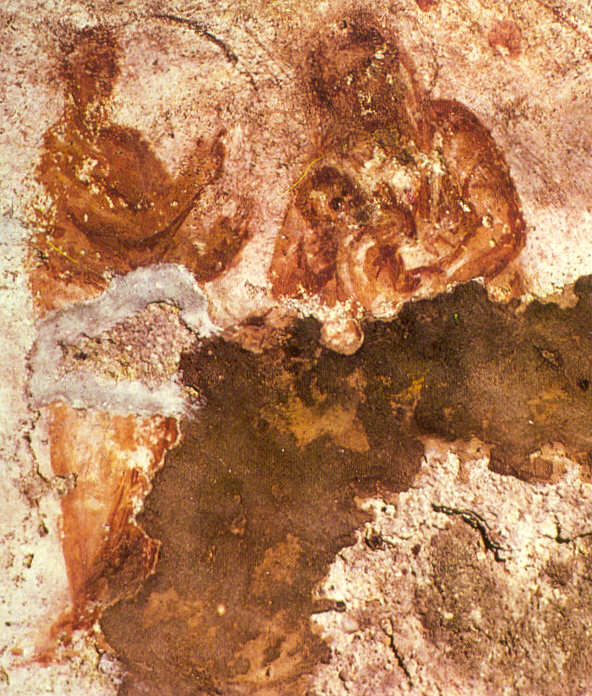
Oldest Known Image of Mary
Devotion to the Mother of God has no shortage of artistic representation.
Found in the Catacomb of Priscilla in Rome, dating from the late second century, is the oldest known image depicting the Blessed Virgin Mary. In the picture, she is nursing the Infant Jesus. The third figure in the image may be the prophet Balaam. Here he is pointing to a star which is outside of the frame. The star is a reference from Numbers 24:17
I shall see him, but not now: I shall behold him, but not near. A STAR SHALL RISE out of Jacob and a sceptre shall spring up from Israel: and shall strike the chiefs of Moab, and shall waste all the children of Seth.
Sunday, January 10, 2010
Guide to Latin Prayers: Lesson 04 - Ave Maria
Hail Mary
The most popular of all Marian prayers, the Ave Maria has two distinct parts: scriptural and intercessory. The first part's use in the Church's liturgy dates back as far as the fifth century. The second part we find traces back to about the fifteenth century, but with two different endings. In the writings of St. Bernardine of Sienna and the Carthusians, the prayer ends with pray for us sinners. In the writings of the Servites, however, we find the prayer ending with pray for us now and at the hour of our death. Pope St. Pius V gave us the ending we use today when he promulgated the reformed Breviary in 1568.
Ave Maria
(AH-vay Mah-REE-ah)
gratia plena
(GRAH-tsee-ah PLAY-nah)
Dominus tecum
(DOH-mee-noos TAY-koom)
benedicta tu in mulieribus
(beh-neh-DEEK-tah too een moo-lee-AIR-ee-boos)
et benedictus fructus ventris tui Iesus
(eht beh-neh-DEEK-toos FROOK-toos VEHN-trees TOO-wee YAY-soos)
Sancta Maria Mater Dei
(SAHNC-tah mah-REE-ah MAH-tair DAY-ee)
ora pro nobis peccatoribus
(OHR-rah proh NOH-bees pehk-ah-TOHR-ee-boos)
nunc et in hora mortis nostrae
(noonk eht een HOHR-ah MOHR-tees NOH-stray)
This concludes the fourth lesson. Practice often.
Sunday, December 6, 2009
Guide to Latin Prayers: Lesson 03 - Pater Noster
Our Father
Taken from the Baltimore Catechism No. 4:
This is the most beautiful and best of all prayers, because Our Lord Himself made it. (Matt. 6:9; Luke 11:2). One day when He was praying and explaining to His Apostles the great advantages of prayer, one of them said to Him: "Lord, teach us to pray." Then Jesus taught them this prayer. It contains everything we need or could ask for. We cannot see its full meaning at once. The more we think over it, the more clearly we understand it. We could write whole pages on almost every word, and still not say all that could be said about this prayer. It is called "the Lord's," because He made it, and sometimes the "Our Father," from the first words.
Pater noster
(PAH-tehr NOHS-tehr)
Qui es in caelis
(quee ehs een CHAY-lees)
sanctificetur nomen tuum
(sahnc-tee-fee-CHAY-toor NOH-mehn TOO-oom)
adveniat regnum tuum
(ahd-VAY-nee-aht RAY-nyoom TOO-oom)
fiat voluntas tua
(FEE-aht voh-LOON-tahs TOO-ah)
sicut in caelo et in terra.
(SEE-koot een CHAY-loh eht een TAYHR-rah)
Panem nostrum quotidianum
(PAH-naym NOHS-troom quoh-tee-dee-AH-noom)
da nobis hodie
(dah NOH-bees HOH-dee-ay)
et dimitte nobis debita nostra
(eht dee-MEET-tay NOH-bees DAY-bee-tah NOHST-rah)
sicut et nos dimittimus debitoribus nostris
(SEE-koot eht nohs dee-MEET-tee-moos day-bee-TOH-ree-boos NOHST-rees)
et ne nos inducas
(eht nay nohs een-DOO-kahs)
in tentationem
(een tehn-TAH-tsee-oh-nehm)
sed libera nos a malo.
(sehd LEE-behr-ah nohs ah MAH-loh)
This concludes the third lesson. Practice often.
Subscribe to:
Posts (Atom)